Specimen: TADPOLE.
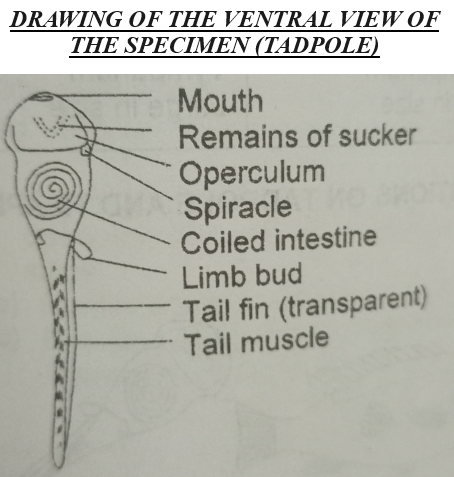
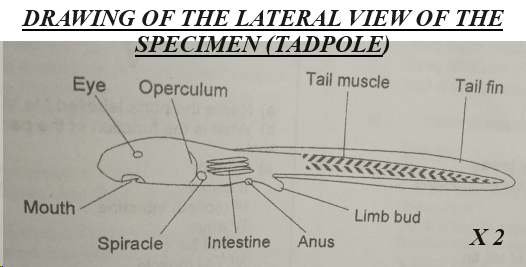
State four observable features on the ventral part of the tadpole.
- Remains of sucker
- Presence of limb bud
- Presence of tail fin
- Also, tail muscle is present.
- Anus
- Long coiled intestine.
Give the diet of the specimen with reasons
- The diet of the specimen is Vegetation (phytoplankton)/pond weeds.
Reasons
- Presence of horny jaws
- Possess long coiled intestine
Which structure of the specimen is not used at this stage?
- The limb is because the tail fin is used for swimming.
State the observable features that classified the specimen as an aquatic organism.
- Possess tail fin
- Presence of gills
- Have a streamlined body.
- Also, the presence of operculum.
Give the adaptive features of locomotion in the specimen.
- The specimen possesses a long tail fin for forward movement.
- It has a streamlined shape to reduce resistance in water.
State the possible habitats of the specimen.
- Slow-moving water
- Stagnant water
- Freshwater
- Pond
Biology practical questions and answers (section 4).
biology practical questions and answers (Section 1).
Biology Practical questions and answers (Section 2).
Biology practical questions and answers on plant physiology (3)
Explain briefly how the specimen undergoes gaseous exchange.
- Water enters the mouth and passes down the pharynx,
- The water then passes over the gills into the bronchial chamber
- It then passes out through the spiracle.
- As the water moves through this process,
- Dissolved oxygen diffuses into the blood capillaries in the gills to replace carbon dioxide.
State the adaptive features of feeding in the specimen.
- Possess the mouth to allow water into the organism.
- The presence of a horny jaw for nibbing phytoplankton (water weeds).
- Long coiled intestine for digesting water weeds.
- Also, possess gill rackers to strain food from water that is passing over the gills.
Study the diagram below carefully and use it to answer the questions that follow.
Name the parts labeled I to VI.
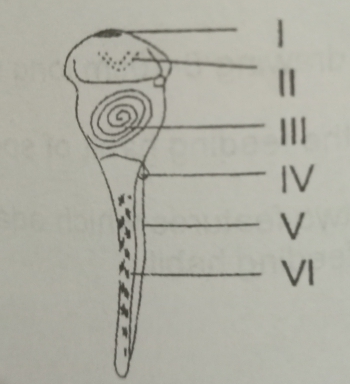
|
LABEL |
NAME |
|
I |
Mouth |
|
II |
Sucker |
|
III |
Coiled Intestine |
|
IV |
Anus |
|
V |
Tail Fin |
| VI |
Tail muscle |
State the function of the parts labels I, II, III, IV, V, and VI.
|
Parts |
Functions |
| I | · For feeding.
· Also, allow water to flow into the organism. |
| II | · It is used for attachment to weeds to avoid being carried away by water currents. |
| III | · For digestion. |
| IV | · Egestion of faeces. |
| V | · For Swimming. |
Join Enlighten Knowledge WhatsApp platform.
Join Enlighten Knowledge Telegram platform.
Follow our:
About Author